Friday, June 19, 2009

Helen Mirren is Phèdre!

See Helen Mirren on stage in London in Jean Racine's Phèdre at your local theatre. This is an experiment in presenting the best of theatre on the screen and will be the first of four plays from the National Theatre in London. It is being screened worldwide, via a satellite feed in HD, on Thursday June 25.
Racine's play, first performed in 1677, has been re-translated by Brit Poet Laureate Ted Hughes. Here is an article on the play with various British reviews.
http://latimesblogs.latimes.com/culturemonster/2009/06/helen-mirren-in-ph%C3%A8dre-what-did-the-critics-think.html
Here's Helen promoting the event
http://www.youtube.com/watch?v=tc6umkTLcao
Canadian tickets can be bought online or at the theatre. Visit www.cineplex.com/events
Julian D.

Tuesday, June 9, 2009

Our HOME is in Peril

We are living in exceptional times. Scientists tell us that we have 10 years to change the way we live, avert the depletion of natural resources and the catastrophic evolution of the Earth's climate.

The stakes are high for us and our children. Everyone should take part in the effort, and HOME has been conceived to take a message of mobilization out to every human being.

For this purpose, HOME needs to be free. A patron, the PPR Group, made this possible. EuropaCorp, the distributor, also pledged not to make any profit because Home is a non-profit film.

HOME has been made for you : share it! And act for the planet.

Yann Arthus-Bertrand (co-writer/director)

This feature length documentary has been made available free because of its importance. It tells of our planet's current state with stunning cinematography, phenomenal images, haunting music and compelling narrative. You must put aside one and a half hours to watch it. It is being made available for only a short period of time. Here is a link to watch it now.

http://www.youtube.com/watch?v=jqxENMKaeCU

Here are two articles.

http://www.huffingtonpost.com/cameron-sinclair/home-a-truly-global-event_b_212112.html

http://en.wikipedia.org/wiki/Home_(documentary)

And the official site: http://www.youtube.com/homeproject

It is too late to be a pessimist. Everyone plays a part in the solution. Everyone is a link in the chain.

Julian D.

Wednesday, May 27, 2009

The Soloist

Both Steve Lopez's L.A. Times columns and book on troubled musical genius Nathaniel Anthony Ayers received incredible interest from the public. Unfortunately, perhaps due to poor distribution, or in the mind of some critics, poor direction, the movie based on this fascinating and important story has not fared as well. Few people deny the power of the performances from two great actors, Robert Downey Jr. and Jamie Foxx. Our audience were extremely moved by the film and and the importance of the story.

When Steve Lopez came upon Nathaniel Anthony Ayers playing beautiful music from a 2-stringed violin he could not have foreseen that not only would this make a fascinating story but also ineveitably alter both of their lives. Nathaniel was a homeless person suffering from schizophrenia but had at one time been a student at Julliard.

The movie was made while the book was in progress and as is inevitable the director, Joe Wright (Pride and Prejudice, Atonement) and the screenwriter, Susannah Grant (Erin Brockavich) made a number of changes in content and chronology.

Check the excellent production notes on the film.

Also check the video from 60 minutes with Morley Safer.

Julian D.

Tuesday, May 26, 2009

Welcome to the Sticks

Danny Boon (right in the photo) has become a favourite of our film fest. This is the third picture that we have screened in which he has been involved. He had a small role in Joyeux Noel (Merry Christmas) and a leading role in Mon Meilleur Ami (My Best Friend). Here he is multi-tasking as he is not only one of the leads but also the director/writer/editor of the film. He has become one of France's biggest stars grossing some $30 million last year.

Welcome to the Sticks (Bienvenue chez les Ch'tis) has become France's all-time most popular film surpassing Titanic and has grossed nearly $200 million U.S. and on over 20 million tickets sold. And that's in a population of 67 million. It has been purchased for an American remake by Will Smith's Production company.

It's a laugh-out-loud comedy and our audience loved it. Much of the humour comes from the extreme differences between the French language and the Ch'ti dialect. The subtitlers have done a brilliant job in creating subtitles that carry the essence of the dialogue without being literal translations.

The Storyline
Although living a comfortable life in Salon-de-Provence, a charming town in the South of France, Julie (Zoé Félix) has been feeling depressed for a while. To please her, Philippe Abrams (Kad Merad), a post office administrator, her husband, tries to obtain a transfer to a seaside town, on the French Riviera, at any cost. The trouble is that he is caught red-handed while trying to scam an inspector. Philippe is immediately banished to the distant unheard of town of Bergues, in the Far North of France. Leaving his child and wife behind, the crucified man leaves for his frightening destination, a dreadfully cold place inhabited by hard-drinking, unemployed rednecks, speaking an incomprehensible dialect called Ch'ti. Has Philippe been seen to hell...

The story was a very personal one for Danny as he was born in the region in which the film takes place and he wanted to show that the prejudices of the southern French toward the north was unwarranted and that the northerners were kind, friendly and generous and the location beautiful.

This webpage has a superb set of production notes.

http://thecia.com.au/reviews/w/welcome-to-the-sticks-bienvenue-chez-les-ch-tis.shtml

Julian D.

Necessities of Life

Our audience of 468 members were treated to a beautiful and poignant film depicting a difficult chapter in Canadian History. Documentarian Benoit Pilon has meticulously crafted a film with a very realistic tone and setting. The amazing Inuit actor, Natar Ungalaaq, was phenomenal as Tivii, a displaced Inuit suffering from tuberculosis. Alone and dying in a Quebec sanatorium, he is saved only by the love and caring of a white Sister Nurse and a young boy caught between the world of the Inuit and that of the dominant European based millieu.

The audience was nearly unanimous in its positive reaction to The Necessities of Life. As one of out members said "And they say Canadians can't make great films!"

Necessities of Life was Canada's contender for Foreign Language Oscar and was nominated for 8 Genie Awards winning 4 prestigious ones: Best Director (Benoit Pilon), Best Actor (Natar Ungalaaq), Best Screenplay (Bernard Émond), Best Editing (Richard Comeau). It also won Jutra awards for Best Film, Best Director and Best Screenplay. It was filmed in Quebec City and Iqaluit Nunavut.

Click here for an interview with the director.


Julian D.

Saturday, May 2, 2009

The Stone of Destiny

Our two screenings of 'The Stone of Destiny' brought in an audience of 542 people and very positive comments. There were a goodly number of Scottish enthusiasts judging from the singing of Scottish songs on the way out and the sonorous rolling r's in some of the after film commentary. Following his much beloved "The Snow Walker" director Charles Martin Smith has created another big AFF hit. Beautifully filmed on location and featuring a marvelous ensemble cast, Smith tells this heart-warming, true adventure tale of spunk, pride and patriotism in a light-hearted, humourous, romantic and exciting fashion. The story details, with a little literary license, the real events of Scottish Nationalist Ian Hamilton's attempt to recover the Stone of Destiny (aka Stone of Scone), from the British, with the help of a makeshift motley group of passionate youths. Smith filmed in the actual locations where the events occurred including the rooms where the event was plotted and the streets where the co-conspirators lived; he was the first filmmaker in 40 years to be able to film in Westminister Abbey. Ian Hamilton, who is in his 80's now, was on set contributing much to the storyline.

Here's a nice interview with the Ian Hamilton where he also gives his impressions of the film.
http://www.booksfromscotland.com/Authors/Ian-Hamilton

The cast was superb, composed of a blend of fine young and veteran actors. Robert Carlyse (The Full Monty), Peter Mullan (Boy A and The Magdalene Sisters) and Brenda Fricker (My Left Foot) provided the veteran chops while Charlie Cox (Stardust), Kate Mara (Brokeback Mountain), Billy Boyd (The Lord of the Rings) and Steven McCole (Band of Brothers) exuded the exuberance and passion of youth.

The soundtrack was uniquely fine featuring a number of moving Scottish songs.

Julian D.

Thursday, April 9, 2009

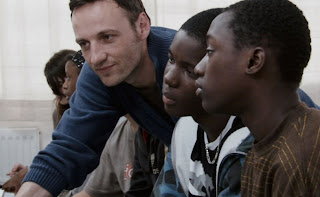
The Class (Entre Les Murs)

Our two screenings of 'The Class' (French title 'Entre Les Murs' or 'Between the Walls') brought in 594 people and mixed reviews.

Despite the fact that 'The Class' was the first French film in 21 years to win the Palme D'or (the top prize) at Cannes and that it is one of the most highly rated films by critics (97% on Rotten Tomatoes (100% from the 30 top critics) and 92% on Metacritic) it remains a film over which audiences are quite a bit less positive.

Check out the links below to read some reviews on 'The Class'.
Rotten tomatoes Top Critics reviews
Metacritic review site

Also, I recommend that you look at the excellent production notes (select press kit from this link) should you be interested in more information on what the author/teacher (François Bégaudeau) and director (Laurent Cantet) hoped to accomplish with this film.

Here are some excerpts from the production notes that hopefully will tease you into reading the ful notes.

François Bégaudeau. The aim of my book was to document one school year, sticking close to daily experiences. So there was no clear narrative line, no fictional plot centered around any one particular event. There were disciplinary meetings, but they were mostly events among many which followed their course. With this material, Laurent and his co-screenwriter Robin Campillo extracted the storyline that they were interested in. My book was the result of situations ; Laurent and Robin chose some of these to mold into fictional form. They did not choose "characters" in the strict sense of the term ; they constructed them, sometimes by grafting together several kids from the book.

Laurent Cantet. We wrote an initial summary, a backbone of the film, destined to be irrigated and modified throughout the year of preparation according to a plan I had already tried out in Ressources humaines (Human Resources). The idea was to use an existing school and during the filmmaking process, to integrate all the players of academic life. The first door that we knocked on was that of the Françoise Dolto Junior High in Paris' 20th arrondissement. It was the right one (we would have filmed there, if the school wasn’t undergoing construction). All the adolescents in the film are students at Dolto ; all the teachers teach there, including Julie Athénol is the counselor and Mr. Simonet is the assistant principal. With the exception of Souleymane’s mother, whose role is the most fabricated, the parents in the film are those of the students in real life.

Laurent Cantet. Those moments where the class discussion deviated are the ones that interested me the most, and the film is built on them. Few teachers take as many risks with their students : the risk to fall off track, the risk to fail. It is obviously easier to say that one has successfully transmitted this or that piece of knowledge through a lecture than by some induced method. This requires a sang-froid for which many people would criticize François, and for which many people would envy him. There's a bit of Socrates in that man!

François Bégaudeau. Most films about adolescents show them as monosyllabic. For us, without a doubt, the dominant force of The Class is the loquacious and lively adolescent, rather than melancholic and inhibited. Each spectator is free to imagine Esmeralda daydreaming alone in her room, but the film only shows her in the classroom, where her presence makes her a pure slice of life. The Class deals with how the lacunae of language affect everyone. All the students are susceptible to masterful moments of talk, but this can be derailed at any moment. Not only for the students, but also for the teacher.

Laurent Cantet. The film does not try to defend nor accuse either side. They all have their weaknesses and outbursts, their moments of grace and pettiness. Each one can exhibit both clairvoyance and blindness, comprehension and injustice. I even have the impression that the film expresses something paradoxically positive: a school is sometimes very chaotic, useless to cover its face, there are moments of discouragement but also great moments of grace, immense happiness. And from this great chaos, a lot of intelligence can be born.

François Bégaudeau. A school constantly creates wonderful situations. But we all know at the same time that it is, in the end, discriminatory, unequal, it fabricates reproduction, etc. This tension was at the basis of the film. More generally, I find the same kind of tension in my favorite films. In the present of each scene, there is so much energy at work that everyone is saved. But the progression of the screenplay takes us to rupture, impossibility, catastrophe. Each situation is a utopia, but the sum of situations is tragic. This is exactly the case in Laurent’s film. We can see in it the story of a failure. On the other hand, we can retain moments of a concrete utopia.

Your thoughts regarding the film would be much appreciated.

Julian D.